
Products / 001
Forge.
Built to build.
A modular manufacturing platform in development. Intelligence, machines, and tools, brought together to turn ideas into things.
In development / Modular manufacturing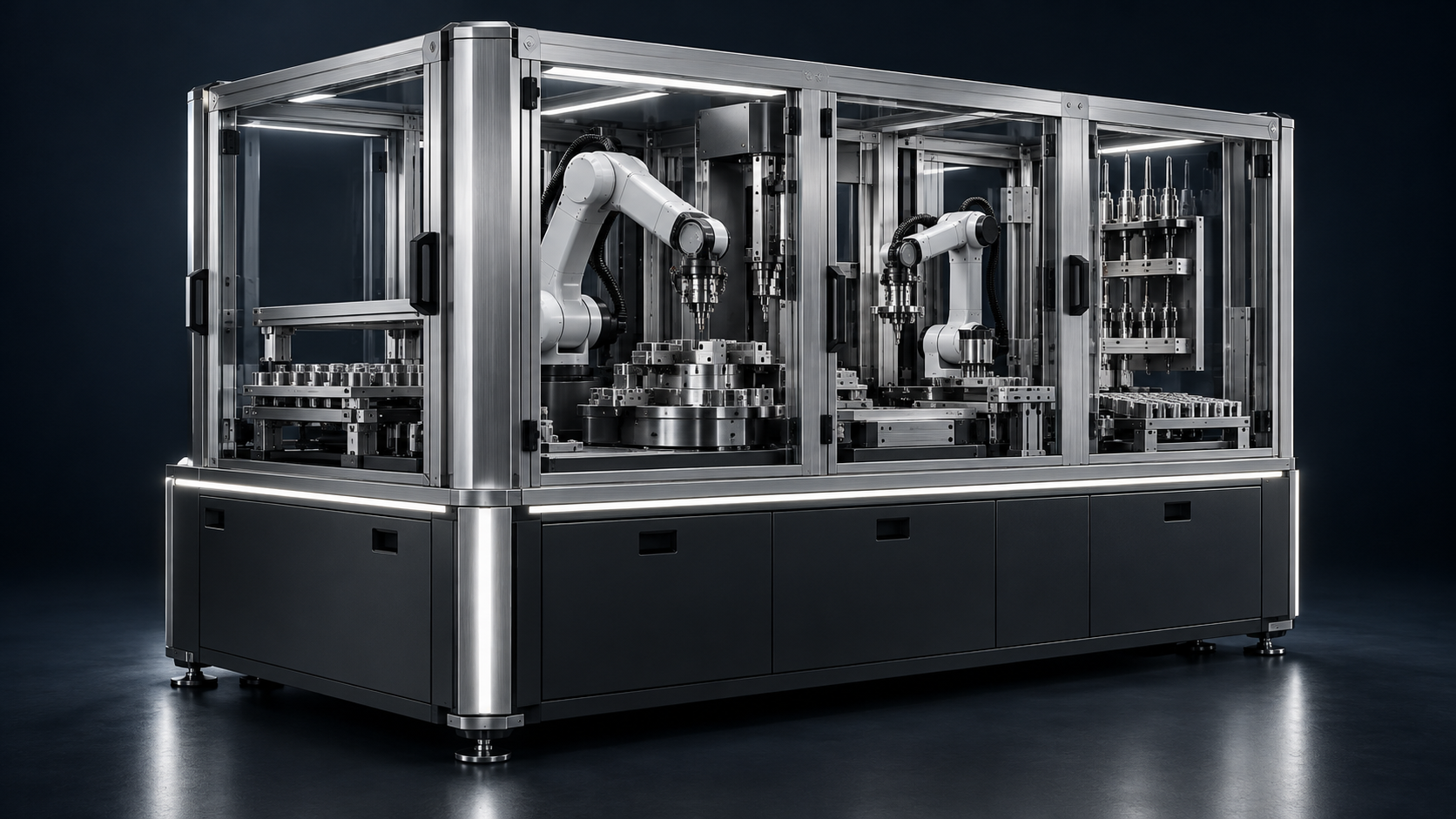
More than
a pair of hands.
A robot cannot reproduce a factory on its own. The long-term vision for Forge connects intelligent planning, capable robots, conventional machines, and the processes that make them work together.
Some machines will be sophisticated. Others will do one simple job well. The objective is a system that can coordinate both.
- Intelligence
- Translate a defined objective into a sequence of tasks, with checks before moving to the next step.
- Physical work
- Coordinate manipulation, fabrication, assembly, and material movement using appropriate machines.
- Verification
- Measure what was built, compare it with requirements, and identify work that needs correction.
- Replication
- Gradually increase the share of components and production equipment the system can help make.
The intended system described here is a development vision, not a statement of demonstrated capabilities.
An idea becomes
a physical process.
Explore the three parts of the manufacturing loop we want to build.
Define the work.
Understand the constraints.
A useful plan starts with the part, material, available equipment, and an explicit definition of success. The aim is to translate that into ordered tasks that can be checked.
- 01 Requirements & available resources
- 02 Manufacturing & assembly plan
- 03 Reviewable machine tasks
The right machine.
For the right task.
Fabrication, transport, and assembly need different tools. Forge's ambition is to coordinate those tools while respecting machine limits, safety controls, and inspection requirements.
- 01 Prepare materials & tooling
- 02 Fabricate & assemble
- 03 Inspect the result
Prove it works.
Then make it repeatable.
A successful build is a starting point. The next challenge is repeating it reliably, reducing intervention, and applying that process to components and equipment for another machine.
- 01 Test against requirements
- 02 Correct & repeat the process
- 03 Build more manufacturing capacity
The best way to predict the future is to create it.
— Alan Kay
These are the kinds of milestones that would move Forge toward self-replicating manufacturing. They are goals, not completed results or promised dates.
- 01 / A useful task
Repeatable manufacturing.
The test: complete a defined task to a stated quality requirement over repeated attempts. Record failures, setup work, and every human intervention.
- 02 / Another robot
Machine assembly.
The test: manufacture or assemble selected components for another machine, then verify that machine's function. Make purchased parts and external work explicit.
- 03 / Another production cell
Growing capability.
The test: help produce the tooling, structures, and equipment needed for a second cell, and show that the new cell can perform useful work.
- 04 / Beyond Earth
Factories outside Earth.
The challenge: adapt manufacturing to local materials, limited energy, remote maintenance, and unfamiliar environments. This requires solving the dependencies of self-replicating factories on Earth first.
What Forge means.
And what it doesn't.
Can Forge fully self-replicate today?
No demonstrated full self-replication is presented here. Forge is in development, and complete self-replication is the long-term goal. The images illustrate that vision rather than documenting a finished capability.
Is this one robot or an entire factory?
The vision starts with AI-powered robotics and expands to a coordinated manufacturing system. A factory includes far more than robot arms: tooling, fabrication equipment, inspection, power, and material handling all matter.
Does self-replication mean no outside inputs?
Not at the outset. Early systems would depend on supplied materials, purchased components, energy, and human support. Meaningful progress means stating those dependencies clearly and reducing them over time.
Why start on Earth if the ambition includes space?
Earth is where useful tasks, repeatable processes, and new manufacturing capacity can be tested first. Operating elsewhere adds major constraints. It is a direction to work toward, not a near-term deployment claim.
What happens to human creativity?
It is the reason for the project. The aim is to make physical creation less dependent on repetitive labor, so people can spend more time inventing, exploring, and deciding what is worth making.
The questions behind Forge.
Read the thinking behind the ambition.